
Courage can be difficult to describe with ordinary words. It is more than simply being fearless. Courage is the strength to face fear, uncertainty, pain, or difficulty and keep moving forward anyway. That is why vivid language can make courage much easier to understand.
This collection of similes for courage gives you fresh ways to describe bravery, determination, confidence, resilience, and fearless action. Whether you are writing a story, poem, speech, essay, caption, or character description, these comparisons can help your writing feel stronger and more memorable.
You will find original courage similes organized by different moods and writing situations. Some are powerful and dramatic, while others are poetic, emotional, creative, or suitable for everyday writing. You will also learn how to choose the right simile and use it naturally without making your sentences sound forced.
What Are Similes for Courage?
A simile for courage compares courage or bravery to something familiar using words such as “like” or “as.” The comparison gives readers a clear mental picture of what courage looks or feels like.
For example:
Her courage was like a lighthouse standing against a violent storm.
This sentence does not simply say that she was brave. It compares her courage to a lighthouse that continues shining despite dangerous weather. The image suggests strength, persistence, and hope under pressure.
Another example is:
He stood as steady as an old oak during the crisis.
The comparison between the person and an old oak creates an image of stability and strength.
Courage can take many forms. It can be loud and dramatic, such as confronting a powerful enemy. It can also be quiet, such as admitting a mistake, starting again after failure, or speaking honestly when the truth is uncomfortable.
That means the best similes for courage depend on the kind of bravery you want to describe.
Why These Similes Matter
Courage is an abstract idea. Readers cannot physically touch courage or see it sitting on a table. A strong simile gives that invisible quality a concrete image.
Consider the difference:
Simple:
She showed great courage.
Vivid:
Her courage burned like a torch in the middle of the darkness.
The first sentence tells the reader that she was brave. The second creates a picture. The torch suggests light, persistence, and strength when everything around her feels uncertain.
Similes can also help establish mood. A warrior’s courage might be compared to thunder, iron, or a mountain. A child’s courage might be compared to a tiny candle, a young tree, or a small bird taking its first flight.
Here’s why.
A carefully chosen comparison allows you to communicate how courage feels, not merely that it exists.
Similes Make Characters More Memorable
In fiction, courage is often an important character trait. Instead of repeatedly writing that a character is brave, you can show that bravery through imaginative comparisons.
For example:
Her courage was like a small flame that refused to die in the rain.
This suggests that her bravery is being tested but remains alive.
Similes Strengthen Emotional Writing
Courage often appears during emotionally difficult moments. A powerful simile can make those moments more meaningful.
His courage rose like the morning sun after a night of doubt.
The image connects bravery with renewal and hope.
Similes Add Personality to Your Writing
Different comparisons create different impressions. A courage simile involving fire can sound passionate. A comparison involving a mountain can sound strong and dependable. A comparison involving a bird can feel hopeful and freeing.
The right image helps your writing develop its own voice.
How to Choose the Right Simile
Choosing a good simile is not simply about finding the strongest possible image. The comparison should match the person, situation, emotion, and tone of your writing.
A dramatic battle scene may need a powerful image. A personal essay may benefit from something quieter and more emotional.
Use the table below to guide your choice.
| Writing Need | Useful Image | Example Direction |
| Strong bravery | Mountain, iron, oak | Courage as steady as a mountain |
| Fearless action | Fire, thunder, lightning | Courage striking like lightning |
| Quiet courage | Candle, seed, sunrise | Courage glowing like a candle |
| Emotional bravery | Heart, bridge, dawn | Courage opening like dawn |
| Determination | River, arrow, train | Courage moving like a river |
| Heroic writing | Shield, sword, fortress | Courage standing like a fortress |
| Hopeful writing | Star, sunrise, bird | Courage shining like a star |
| Resilience | Tree, stone, roots | Courage rooted like an ancient tree |
| Youthful courage | Sparrow, spark, seedling | Courage growing like a young tree |
| Inspirational writing | Flame, sunrise, beacon | Courage burning like a beacon |
Think About the Emotion
Ask yourself what kind of courage you are describing.
Is it:
- Quiet courage?
- Physical bravery?
- Emotional strength?
- Moral courage?
- Courage during failure?
- Courage in the face of danger?
- Courage to begin again?
The answer will help you select an image that fits naturally.
Match the Tone
A humorous story should not suddenly use an extremely dramatic comparison unless the contrast is intentional.
Likewise, a serious speech may benefit from a dignified image rather than a silly one.
Strong writing does not always require the biggest comparison. It requires the right comparison.
Best Similes for Courage
Powerful Similes for Courage
- Her courage was like a mountain standing against the storm.
- His bravery burned like a furnace that refused to cool.
- Their courage was as solid as a fortress built on stone.
- She faced the danger like a warrior walking into battle.
- His courage struck like thunder across a silent valley.
- Her spirit was as strong as iron beneath a hammer.
- Their bravery rose like a wall against a rushing tide.
- His courage stood like an oak with roots beneath the earth.
- She was as fearless as a flame dancing in a hurricane.
- His determination was like a river cutting through rock.
- Her courage shone like steel beneath the morning sun.
- Their bravery was as firm as a cliff above the sea.
- His heart beat with courage like a drum before battle.
- She stood as boldly as a tower above the battlefield.
- His courage was like a hammer striking fear into silence.
These comparisons work particularly well when you want courage to feel strong, imposing, and difficult to defeat.
Emotional Similes for Courage
- Her courage was like a candle glowing through a sleepless night.
- His bravery rose like a sunrise after endless darkness.
- Her courage felt like a hand reaching through the fog.
- His heart held courage like a secret treasure.
- Their bravery was like a small star refusing to disappear.
- Her courage bloomed like a flower after a harsh winter.
- His spirit was like a warm light in an empty room.
- Her bravery was as gentle as dawn but as persistent as daylight.
- His courage grew like roots beneath freshly turned soil.
- She carried courage like a letter she had promised to deliver.
- His bravery was like a heartbeat continuing through fear.
- Her courage opened like a window after a long storm.
- Their strength was like morning light touching a darkened room.
- His courage was as tender as hope and as stubborn as love.
- She held onto bravery like a child holding a trusted hand.
These similes are useful when courage comes from love, hope, loss, uncertainty, or emotional struggle.
Poetic Similes for Courage
- Courage moved through her like moonlight across a quiet lake.
- His bravery rose like a silver bird above the clouds.
- Her courage shimmered like sunlight on a restless ocean.
- His spirit burned like a distant star in a winter sky.
- Her bravery flowed like a river beneath the moon.
- Courage wrapped around his heart like a cloak against the cold.
- Her strength appeared like spring after a season of frost.
- His courage floated like a bright lantern through the darkness.
- Her brave heart was like a garden growing between stones.
- Courage followed him like a quiet song through the night.
- Her spirit rose like mist lifting from a mountain valley.
- His bravery sparkled like a single star above an empty road.
- Her courage was like rain falling softly on a thirsty field.
- His heart carried courage like the ocean carries hidden currents.
- Her bravery was as bright as dawn touching distant hills.
Poetic similes are especially effective in poems, creative essays, reflective writing, and emotional storytelling.
Similes for Quiet Courage
Not all courage is dramatic. Sometimes the bravest person in the room is the one who quietly continues.
- Her courage was like a candle quietly holding back the dark.
- His bravery was as steady as a clock ticking through the night.
- She carried courage like a stone kept safely in her pocket.
- His strength was like roots growing silently beneath the ground.
- Her courage stood like a small tree beneath falling snow.
- He faced uncertainty like a traveler calmly reading an unfamiliar map.
- Her bravery was like a whisper that refused to disappear.
- His courage moved like a slow river toward the sea.
- She was as quietly brave as dawn arriving without a sound.
- His spirit held firm like a knot tied deep inside a rope.
- Her courage rested like a warm ember beneath the ashes.
- He kept going like a lantern carried along a dark road.
- Her bravery was like a seed pushing through packed earth.
- His courage waited like sunlight behind thick clouds.
- She stood with the quiet strength of a tree in winter.
These examples are ideal when you want to show inner strength without making the character seem aggressive or fearless.
Creative Similes for Courage
- Her courage was like a compass pointing north in a spinning world.
- His bravery was like a key unlocking a door marked impossible.
- Her courage danced like a spark inside a machine.
- His spirit was like a kite climbing against a powerful wind.
- Her bravery was like a bridge stretching across an impossible gap.
- His courage moved like an explorer stepping onto an unknown planet.
- She carried bravery like a secret map folded inside her heart.
- His courage was like a match lighting an abandoned room.
- Her spirit rose like a phoenix from a pile of broken plans.
- His bravery was as inventive as a painter creating color from darkness.
- Her courage was like a boat choosing the open sea over the safety of the harbor.
- His determination was like a puzzle piece refusing to accept the wrong place.
- Her bravery flashed like a camera capturing one perfect moment.
- His courage was like a doorway appearing in a wall of doubt.
- Her spirit moved like an arrow searching for its target.
Creative comparisons can make ordinary descriptions feel fresh and unexpected.
Similes for Courage in Difficult Times
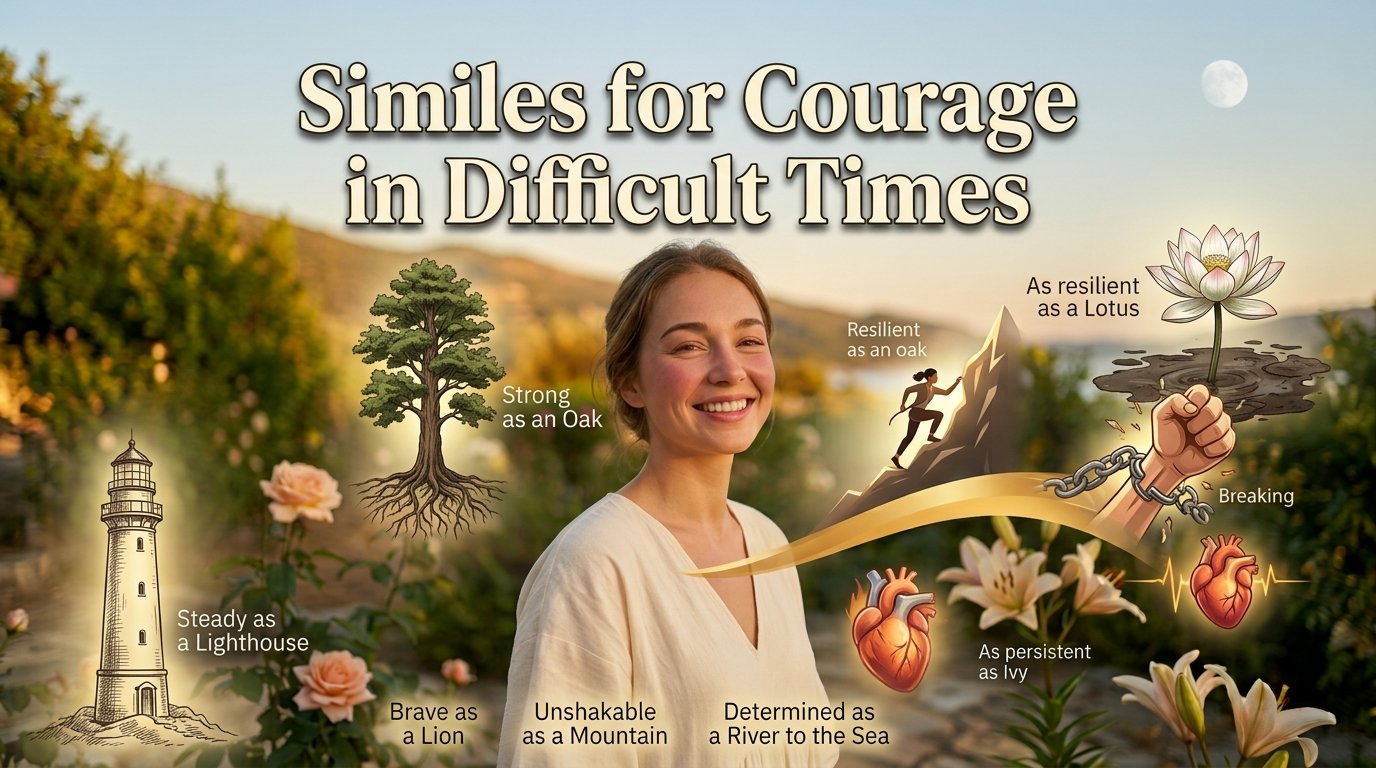
- Her courage was like a bridge surviving beneath heavy traffic.
- His bravery stood like a tree during a season of violent winds.
- Their courage was like a boat staying afloat in rough water.
- She endured the hardship like a mountain enduring years of weather.
- His spirit was as resilient as grass returning after heavy rain.
- Her courage was like a road continuing beyond the broken pavement.
- His bravery was like a roof sheltering a family during a storm.
- She held onto hope like a climber gripping the final rope.
- His courage was like a fire surviving beneath wet wood.
- Her determination moved like a train through heavy snow.
- Their bravery was as persistent as waves returning to the shore.
- His spirit was like a seed surviving beneath frozen ground.
- She carried courage like a shield through a field of uncertainty.
- His strength was like a rope holding firm under enormous weight.
- Her bravery was like daylight slowly breaking through heavy clouds.
These similes fit stories about hardship, recovery, failure, setbacks, difficult decisions, and perseverance.
Similes for Heroic Courage
- His courage was like a shield raised before an advancing army.
- Her bravery stood like a fortress guarding the helpless.
- His spirit burned like a torch carried into enemy territory.
- She faced danger like a knight entering a forbidden castle.
- His courage was as commanding as a flag above a battlefield.
- Her bravery rose like a banner above the crowd.
- His heart was as fearless as a captain steering into rough seas.
- She stood like a guardian before a threatened kingdom.
- His courage struck like a sword against a wall of fear.
- Her bravery was like armor forged in the hottest fire.
- His determination marched like an army toward its goal.
- She carried courage like a warrior carrying an ancient shield.
- His spirit stood as tall as a castle tower above the valley.
- Her bravery was like a beacon guiding travelers through danger.
- His courage thundered like a battle cry across the hills.
These work particularly well in fantasy stories, adventure fiction, heroic narratives, speeches, and dramatic descriptions.
How to Use These Similes Naturally
A simile should support your sentence rather than overpower it. If every sentence contains a dramatic comparison, the writing can quickly become exhausting.
Use a strong simile at a moment where the image actually adds meaning.
Example 1: Character Description
Instead of:
Maria was very brave.
Try:
Maria’s courage was like a candle that refused to go out in the wind.
The second sentence shows that her bravery continues even when circumstances are difficult.
Example 2: Storytelling
Instead of:
Daniel walked toward the dangerous building.
Try:
Daniel walked toward the building with courage like an old oak facing the storm.
The comparison makes his movement feel deliberate and strong.
Example 3: Personal Essay
You could write:
My courage was like a small seed beneath the soil, invisible at first but slowly pushing toward the light.
This works well when describing how confidence develops gradually.
Example 4: Speech
A speech might say:
Courage is like a lighthouse. It does not stop the storm, but it helps us find our way through it.
This kind of comparison is concise, memorable, and easy for an audience to understand.
Example 5: Poetry
A poem could use a softer image:
Her courage rose like dawn, quietly turning fear into light.
The image is emotional without sounding overly complicated.
Common Mistakes to Avoid
Using Clichéd Comparisons Too Often
Some courage comparisons have become extremely familiar. Images such as “brave as a lion” can work, but they may feel predictable.
If you want original writing, consider less obvious images such as a seed pushing through frozen soil or a candle surviving a strong draft.
Making the Simile Too Complicated
A simile should create a clear picture quickly.
For example:
His courage was like a gigantic ancient mountain whose emotional permanence represented the complex psychological architecture of human resistance.
This is unnecessarily complicated.
A cleaner version is:
His courage was like a mountain that refused to move.
Simple language often creates a stronger image.
Mixing Too Many Images
Avoid combining unrelated comparisons in the same sentence.
For example:
Her courage was like fire, a mountain, a bird, and an ocean.
The reader receives too many competing images.
Choose one strong comparison instead.
Using the Wrong Emotional Image
Not every powerful object represents courage.
A comparison to something violent may suggest aggression rather than bravery. A comparison to something fragile may suggest vulnerability rather than strength.
Always ask what your chosen image communicates.
Repeating the Same Comparison
If you use fire several times in the same paragraph, the language can become repetitive.
Try moving between different image families:
- Nature
- Weather
- Light
- Architecture
- Animals
- Journeys
- Objects
- Water
- Space
- Music
This keeps your writing varied.
Forgetting the Context
A funny story may need a playful simile, while a serious memorial speech may need something respectful and restrained.
Context determines meaning.
Tips for Writing Better Similes
1. Start With the Emotion
Before choosing an image, identify the exact feeling.
Instead of simply asking, “How can I describe courage?” ask:
What kind of courage is this?
It might be determined, frightened, hopeful, heroic, quiet, emotional, rebellious, or persistent.
2. Use Concrete Images
Concrete objects are easier to visualize.
Instead of:
His courage was like something strong.
Try:
His courage was like an oak tree gripping the earth.
The second version gives readers something they can actually imagine.
3. Use Nature Carefully
Nature offers thousands of useful images.
You can compare courage to:
- Mountains
- Rivers
- Trees
- Seeds
- Stars
- Fire
- Rain
- Dawn
- Birds
- Waves
- Lightning
- Roots
Choose the natural image that best matches your intended emotion.
4. Try Unexpected Comparisons
Originality often comes from using familiar objects in unexpected ways.
For example:
Her courage was like a compass that worked even when every road looked wrong.
A compass is not normally the first object people associate with courage, but it communicates direction during uncertainty.
5. Keep the Language Natural
The reader should understand the comparison immediately.
Good:
He was as steady as a lighthouse in a storm.
Less natural:
He possessed a courage comparable to the theoretical persistence of an immovable lighthouse structure amid meteorological turbulence.
The first sounds human and readable.
6. Make the Image Do Some Work
A good simile should communicate something beyond “this person is brave.”
For example:
Her courage was like a seed breaking through concrete.
This does not only suggest bravery. It also suggests growth, persistence, difficulty, and determination.
7. Avoid Explaining Every Simile
Sometimes the image is strong enough by itself.
Instead of:
His courage was like a mountain. This means he was very strong, stable, dependable, and difficult to defeat.
You can simply write:
His courage was like a mountain, unmoved by the storm around him.
The sentence itself provides enough context.
Similes by Writing Situation
Different situations call for different styles of courage similes. A professional essay may need a clear comparison, while a fantasy story can use something much more dramatic.
| Writing Situation | Best Simile Style | Useful Images |
| School essay | Clear and simple | Mountain, tree, sunrise |
| Personal essay | Emotional | Candle, seed, dawn |
| Poetry | Poetic | Moonlight, stars, river |
| Fiction | Descriptive | Fire, storm, fortress |
| Fantasy | Heroic | Sword, shield, castle |
| Motivational speech | Inspirational | Beacon, sunrise, flame |
| Children’s writing | Simple and visual | Bird, tree, spark |
| Social media caption | Short and punchy | Fire, lightning, star |
| Character description | Personality-focused | Oak, compass, river |
| Adventure story | Dramatic | Storm, mountain, shield |
| Romance | Gentle and emotional | Dawn, heart, light |
| Historical fiction | Powerful and dignified | Iron, fortress, banner |
| Reflective writing | Quiet and thoughtful | Roots, candle, seed |
| Action scene | Intense | Thunder, lightning, fire |
| Inspirational story | Hopeful | Sunrise, beacon, flower |
The strongest choice depends on what you want readers to feel.
A mountain can communicate stability. A flame can suggest passion. A seed can represent developing strength. A lighthouse can represent guidance. A river can suggest persistence and forward movement.
More Ways to Describe Courage With Similes
Courage can appear in ordinary moments as well as dramatic ones. Someone may show bravery by apologizing, asking for help, trying again, defending another person, admitting the truth, or taking the first step toward an unfamiliar goal.
Here are additional original comparisons you can adapt to different contexts:
- Courage can be like a door opening into an unfamiliar room.
- Bravery can feel like taking the first step onto a bridge in heavy fog.
- His courage was like a compass working beneath a cloudy sky.
- Her determination was like roots gripping soil beneath a violent storm.
- Their bravery was like a small boat choosing to leave the harbor.
- His courage was like a match protecting its flame from the wind.
- Her strength was like a river finding another path around a fallen tree.
- His bravery was like a window opening after years of darkness.
- Her courage was like a bird testing its wings above an unfamiliar valley.
- His spirit was like a bell ringing clearly through thick fog.
- Her bravery was like a bridge connecting two sides of a deep canyon.
- His courage was like a lock turning open after years of resistance.
- Her strength was like a tree bending without surrendering its roots.
- His bravery was like a traveler continuing after losing the road.
- Her courage was like sunlight finding a crack beneath a closed door.
These comparisons can be adapted rather than copied word for word. Change the object, setting, verb, or emotional detail to create a simile that fits your own voice.
Why Original Courage Similes Work Better
An original simile gives readers something they have not encountered repeatedly. It can make even a familiar idea feel new.
Compare:
He was brave as a lion.
with:
He carried courage like a lantern through a forest he had never entered.
The first comparison is understandable, but the second creates a more specific scene. The lantern suggests guidance, the forest suggests uncertainty, and the unfamiliar path suggests risk.
That is the real power of a good simile.
You do not need an unusual word. You need an interesting relationship between two ideas.
Courage becomes especially vivid when you compare it to something that continues despite resistance. A tree remains rooted during storms. A river continues around obstacles. A candle keeps burning in darkness. A seed pushes upward despite the weight of the soil.
These images naturally communicate the idea that courage is not always the absence of fear, but the decision to continue despite it.
Final Guide to Choosing a Courage Simile
When you need a simile for courage, start by deciding what you want the reader to understand.
If you want strength, consider a mountain, oak, fortress, or iron.
- If you want hope, consider a star, candle, sunrise, or beacon.
- If you want heroism, consider a shield, sword, banner, tower, or warrior.
- If you want quiet bravery, consider a small flame, tree, compass, seed, or distant light.
The best similes for courage are not necessarily the loudest or most dramatic. They are the ones that help readers see the exact kind of bravery you mean.
A strong comparison can turn a simple statement into a memorable image. Instead of merely telling readers that someone is courageous, show courage as something that stands against storms, grows through darkness, survives pressure, follows a difficult path, or shines when everything else seems uncertain.
That is what makes a simile powerful. It transforms an abstract quality into something readers can see, feel, and remember.
Conclusion
Similes for courage give writers a creative way to describe bravery, strength, determination, and resilience. Instead of simply telling readers that someone is courageous, a well-chosen comparison can show how that courage behaves under pressure. Images such as mountains, flames, rivers, seeds, lighthouses, and sunrise can make abstract emotions easier to understand and remember.
The best courage simile depends on your writing situation and the emotion you want to communicate. A mountain can suggest strength and stability, while a candle can represent quiet courage during difficult times. A river can express persistence, and a sunrise can symbolize hope after fear or hardship. Whether you are writing a poem, story, essay, speech, or personal reflection, original similes can make your descriptions more vivid. Choose comparisons that fit your tone, avoid unnecessary complexity, and focus on creating a clear mental image. With the right similes for courage, ordinary descriptions can become memorable, expressive, and powerful.
FAQs
What is a good simile for courage?
A good simile for courage is “Courage is like a mountain standing against the storm.” It compares bravery to something strong, stable, and difficult to move. Other useful comparisons include courage like a lighthouse in darkness, a candle in the wind, a river cutting through rock, or a seed pushing through hard soil.
What is a metaphor for courage?
A metaphor for courage can describe bravery directly as another thing without using “like” or “as.” For example, “Her courage was a lighthouse in the darkness.” This presents courage as a source of light and guidance. Metaphors for courage often use images such as fire, mountains, shields, stars, roots, and bridges.
What are some creative similes for bravery?
Creative similes for bravery can compare courage to unexpected but meaningful images. Examples include “Her bravery was like a compass in a spinning world,” “His courage was like a doorway through a wall of doubt,” and “Their bravery was like a small boat leaving a safe harbor.” These comparisons emphasize direction, risk, persistence, and determination.
What is a simile for being brave?
A simple simile for being brave is “She was as brave as a lighthouse standing through a storm.” Other options include “He was as steady as an oak,” “She was as fearless as a flame in the wind,” and “He stood as firmly as a mountain.” The best choice depends on the tone and situation of your writing.
What is a poetic simile for courage?
A poetic simile for courage is “Her courage rose like dawn after a night of fear.” It creates an image of light replacing darkness and suggests hope, renewal, and emotional strength. Other poetic comparisons can involve moonlight, stars, rivers, flowers, birds, candles, and sunrise to create softer and more expressive descriptions.
How can I describe courage in creative writing?
You can describe courage in creative writing by comparing it to something that continues despite difficulty. For example, “His courage was like a seed pushing through frozen ground.” This shows persistence rather than simply stating that he was brave. Choose an image that matches the character’s struggle, emotions, personality, and the overall tone of the scene.
What is a simile for quiet courage?
A useful simile for quiet courage is “Her courage was like a candle quietly holding back the darkness.” It suggests powerful bravery without being loud or dramatic. Other quiet courage comparisons include roots beneath the soil, a small flame, a steady clock, a distant star, or a seed growing beneath the earth.
What is a strong simile for courage in difficult times?
A strong simile is “His courage was like a tree standing through a violent storm.” The image communicates endurance, stability, and resilience. Other suitable comparisons include a bridge surviving heavy pressure, a river moving around obstacles, a flame surviving the wind, or daylight breaking through thick clouds after a long period of darkness.
How do I write my own similes for courage?
To write your own courage similes, first identify the kind of bravery you want to describe. Then choose a concrete image that shares that quality. For persistence, consider a river or seed. Connect the two ideas with “like” or “as.”
Why are similes useful for describing courage?
Similes make courage easier to visualize because they connect an abstract emotion with something concrete. Instead of simply saying someone is brave, you can show their bravery as a flame surviving the wind or a mountain resisting a storm. This makes descriptions more vivid, emotional, memorable, and effective in stories, poems, essays, speeches, and other writing.