
Darkness can feel mysterious, peaceful, frightening, lonely, or even beautiful. The right comparison can turn a simple description of darkness into an image readers can almost see.
In this guide, you will find 60+ original similes for darkness organized by mood and writing purpose. Whether you are writing a story, poem, essay, caption, or creative description, these comparisons can help you describe darkness with more emotion and imagination.
What Are Similes for Darkness?
Similes for darkness compare darkness to another person, object, place, feeling, or experience using words such as “like” or “as.” They make an abstract idea easier to visualize.
For example:
- The room was as dark as a sealed cave.
- Darkness spread like ink across the sky.
- The night wrapped around the village like a heavy blanket.
- The hallway looked like a tunnel with no end.
Each comparison gives darkness a different personality.
Darkness does not always have to represent fear. It can suggest silence, mystery, comfort, loneliness, danger, peace, or uncertainty.
Let’s look closer.
Why These Similes Matter
A plain sentence can tell readers that a place is dark, but a strong simile can show them what that darkness feels like.
Compare these two sentences:
The forest was dark.
The forest was dark like a forgotten tunnel buried beneath the earth.
The second sentence creates a stronger mental picture. Readers can imagine the lack of light, the isolation, and the mysterious atmosphere.
They Create Strong Visual Images
Darkness is difficult to see because it represents the absence of light. A simile gives that absence a recognizable shape.
For example:
Darkness hung over the town like a thick curtain.
The reader can imagine darkness covering everything.
They Establish Mood
Different similes create different emotions.
A peaceful comparison might describe darkness as a soft blanket. A frightening comparison might compare it to a predator waiting in silence.
This makes similes useful for fiction, poetry, storytelling, and descriptive essays.
They Make Writing More Memorable
Creative comparisons are easier to remember than ordinary descriptions.
Instead of saying:
The cave was extremely dark.
You could write:
The cave was as dark as the space behind a closed universe.
The comparison gives the sentence a more distinctive voice.
They Add Personality to Darkness
A writer can make darkness seem alive.
For example:
Darkness crept through the streets like a silent thief.
Now darkness appears active rather than simply being a lack of light.
How to Choose the Right Simile
The best simile depends on what you want the darkness to communicate.
Before choosing a comparison, think about the mood, setting, audience, and purpose.
| Writing purpose | Best type of simile | Example |
| Horror | Frightening | Darkness spread like a predator’s shadow. |
| Poetry | Poetic | Darkness rested like velvet over the hills. |
| Mystery | Mysterious | Darkness surrounded the house like an unanswered question. |
| Romance | Gentle | Darkness settled like a soft blanket around them. |
| Adventure | Dramatic | Darkness rose like a wall before the travelers. |
| Children’s writing | Simple | Darkness covered the room like a blanket. |
| Description | Visual | Darkness filled the hallway like spilled ink. |
| Emotional writing | Lonely | Darkness felt like an empty room inside the heart. |
| Fantasy | Magical | Darkness shimmered like black glass beneath the moon. |
| Comedy | Funny | The room was as dark as a sock drawer at midnight. |
Match the Simile to the Emotion
Ask yourself what the darkness should make the reader feel.
- If you want fear, use words associated with danger, predators, traps, or unknown places.
- If you want peace, choose comparisons involving blankets, velvet, calm water, or quiet spaces.
Consider the Setting
A forest, bedroom, cave, city, ocean, and sky can all be dark in different ways.
For example:
The forest was dark like a maze with its walls pulled close.
This works because a forest can feel enclosed and confusing.
For a city:
Darkness settled over the streets like smoke after a distant fire.
The comparison creates a very different atmosphere.
Best Similes for Darkness
The following categories give you original comparisons for different writing situations. Each group focuses on a particular mood or style.
Powerful Similes for Darkness
- Darkness spread like ink spilled across a white page.
- Darkness covered the valley like an enormous black curtain.
- The night rose like a wall between the earth and the stars.
- Darkness swallowed the road like a giant mouth.
- The forest stood as dark as a locked room.
- Shadows gathered like soldiers around a silent fortress.
- Darkness rolled across the hills like a storm without thunder.
- The cave was as dark as the bottom of a forgotten well.
- Night pressed against the windows like a black ocean.
- Darkness moved through the streets like a tide with no shore.
- The tunnel stretched ahead like a road carved through nothingness.
- Darkness fell over the town like a heavy iron gate.
- The sky became as dark as polished coal.
- Night surrounded the house like a fortress wall.
- Darkness stood before them like an endless mountain.
These comparisons work especially well when you want darkness to feel large, overwhelming, or unstoppable.
Scary Similes for Darkness
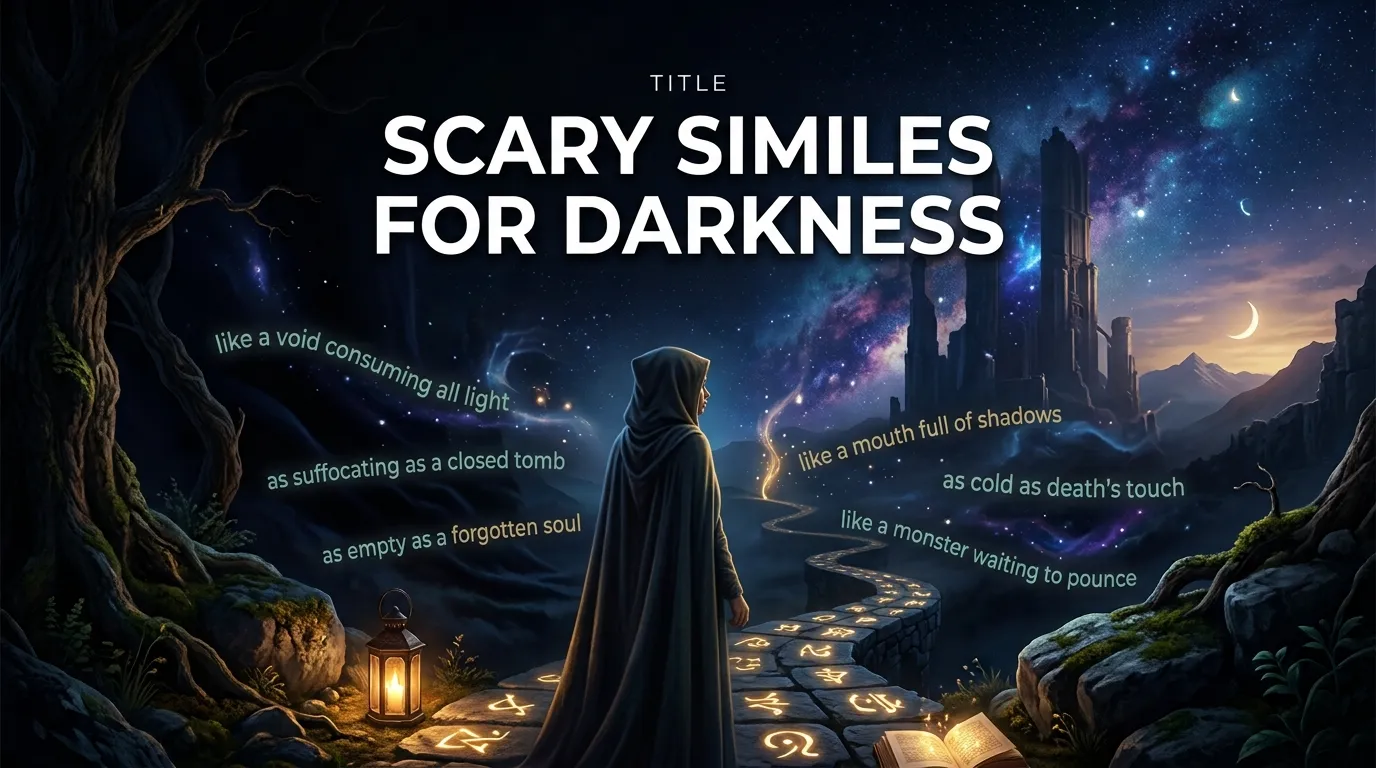
- Darkness crept through the hallway like a predator stalking its prey.
- The room was as dark as a grave beneath the earth.
- Shadows moved along the walls like spiders searching for hiding places.
- Darkness waited outside like something with teeth.
- The forest looked like a mouth waiting to close.
- Night wrapped around the house like a cold hand.
- Darkness followed him like a silent hunter.
- The alley was as dark as a nightmare with no ending.
- Shadows stretched across the floor like crooked fingers.
- The cave opened before them like the mouth of a sleeping beast.
- Darkness surrounded her like an invisible army.
- The abandoned house stood as dark as a forgotten tomb.
- Night crept closer like a wolf circling its prey.
- The hallway disappeared like a path into a nightmare.
- Darkness clung to the trees like a swarm of silent ghosts.
These similes are useful for horror stories, suspense scenes, thrillers, and frightening descriptions.
Beautiful Similes for Darkness
- Darkness rested over the hills like velvet beneath a silver crown.
- The night was as soft as black silk.
- Darkness settled across the lake like a delicate veil.
- The sky looked like polished obsidian beneath the stars.
- Night covered the garden like a velvet blanket.
- Darkness floated above the city like deep blue smoke.
- The evening became as dark as a jeweled box lined with velvet.
- Shadows rested among the trees like quiet feathers.
- Darkness spread across the horizon like spilled midnight ink.
- The night wrapped the world like a soft cloak.
- The moonlit darkness looked like black glass dusted with diamonds.
- Night descended like a curtain embroidered with stars.
- Darkness lay across the fields like satin in the moonlight.
- The sky became as dark as a sapphire turned toward its deepest shade.
- Shadows gathered beneath the trees like folds in dark velvet.
These comparisons are especially effective in poetry, romantic writing, nature descriptions, and atmospheric scenes.
Poetic Similes for Darkness
- Darkness drifted over the earth like a forgotten dream.
- Night unfolded like a poem written in invisible ink.
- Darkness moved across the sky like a slow river of silence.
- The world disappeared like a thought fading at dawn.
- Night gathered around the mountains like a secret no one could explain.
- Darkness rested on the fields like a sleeping thought.
- Shadows stretched toward the moon like unanswered prayers.
- Night arrived like a whisper from another world.
- Darkness filled the valley like a song with no sound.
- The sky became as dark as a memory buried beneath years.
- Darkness floated through the room like a dream without a face.
- Night covered the earth like an unfinished sentence.
- Shadows drifted through the trees like thoughts passing through a quiet mind.
- Darkness waited beyond the window like a story not yet told.
- The night was as deep as a secret kept for centuries.
Poetic similes work particularly well when the goal is to create emotion rather than simple visual description.
Mysterious Similes for Darkness
- Darkness surrounded the mansion like a secret no one dared to uncover.
- The forest looked like a map with its most important paths erased.
- Night covered the village like a hidden message.
- Darkness filled the room like an unanswered question.
- The alley disappeared like a clue leading nowhere.
- Shadows moved across the walls like figures in a dream.
- The road vanished into the night like a secret passage.
- Darkness stood beyond the doorway like a locked mystery.
- The cave was as dark as a book with its final pages missing.
- Night wrapped the town like a mystery without a name.
- Shadows gathered like witnesses refusing to speak.
- Darkness hid the mountains like a curtain concealing a stage.
- The old house appeared like a question carved into the night.
- Night stretched ahead like a puzzle missing its first piece.
- Darkness surrounded them like an unopened letter.
These are useful when you want readers to feel curious, uncertain, or intrigued.
Emotional Similes for Darkness
- Darkness felt like loneliness sitting beside an empty chair.
- The night was as heavy as grief.
- Darkness settled over her like sadness that refused to leave.
- The room felt like a heart after goodbye.
- Shadows surrounded him like memories he could not escape.
- Night covered the town like sorrow beneath a quiet face.
- Darkness pressed against the window like an old regret.
- The empty street looked like a forgotten memory.
- Night felt as lonely as a voice no one answered.
- Darkness followed her like a sadness without a name.
- The room became as empty as a heart after loss.
- Shadows stretched across the floor like memories reaching backward.
- Darkness wrapped around him like the silence after bad news.
- The night seemed as deep as unspoken sorrow.
- Darkness filled the house like a goodbye that never ended.
These similes can add emotional depth to personal essays, literary fiction, poetry, and reflective writing.
Calm Similes for Darkness
- Darkness settled over the room like a warm blanket.
- Night rested on the village like a peaceful hand.
- The bedroom was as dark as a quiet nest.
- Darkness covered the garden like soft wool.
- Night arrived like a gentle lullaby.
- Shadows rested across the floor like sleeping cats.
- Darkness surrounded the house like a protective cloak.
- The sky became as dark as calm water before sunrise.
- Night settled over the lake like a silent blanket.
- Darkness drifted through the room like quiet music.
- The forest rested in darkness like a sleeping child.
- Night wrapped the hills like a soft shawl.
- Darkness lay over the fields like peaceful sleep.
- The room felt as dark as a cozy corner at bedtime.
- Night covered the town like a blanket, keeping everything still.
These work well when darkness represents rest, safety, sleep, or tranquility rather than danger.
Creative Similes for Darkness
- Darkness poured across the sky like black paint from an overturned jar.
- Night spread like coffee dropped into clear water.
- Shadows crawled across the walls like spilled ribbons.
- Darkness filled the street like smoke trapped inside a bottle.
- The sky looked like a giant sheet of black paper.
- Night gathered like ink collecting at the bottom of a glass.
- Darkness moved through the room like a magician’s disappearing trick.
- The forest became like a painting erased with one enormous brushstroke.
- Shadows stretched like long pieces of charcoal across the ground.
- Darkness covered the city like black frosting over a giant cake.
- Night rose like dye spreading through white cloth.
- The room became like an unlit theater before the performance.
- Darkness folded around the mountains like black paper around a gift.
- The street vanished like words erased from a page.
- Night filled the sky like a blank canvas waiting for stars.
These comparisons are ideal when you want your writing to sound fresh, imaginative, and distinctive.
Funny Similes for Darkness
- The room was as dark as a refrigerator with the light bulb removed.
- The hallway was like a sock drawer at midnight.
- The basement was as dark as a detective’s mood on a Monday morning.
- Darkness filled the room like someone had turned off the entire universe.
- The cave was as dark as a phone at one percent battery.
- The bedroom was like a movie theater after everyone had gone home.
- The basement looked as dark as a forgotten cupboard.
- The hallway was like walking through a giant closed eyelid.
- The room became as dark as a cat hiding under a couch.
- Darkness arrived like someone had misplaced the sun.
- The closet was as dark as a mystery novel with all the lights off.
- The garage looked like midnight had moved in permanently.
- The tunnel was as dark as a pair of sunglasses at night.
- The room disappeared like a magician had switched off reality.
- The basement was like the inside of a pocket with the zipper closed.
Funny similes can make dark scenes feel lighter and more entertaining, especially in casual writing or humorous stories.
Dramatic Similes for Darkness
- Darkness descended like an army marching across the horizon.
- Night fell like a curtain at the end of the world.
- Darkness rose like a giant wave swallowing the shore.
- The sky became as dark as a battlefield before the first command.
- Shadows gathered like thousands of silent witnesses.
- Night covered the city like an enormous crown of black iron.
- Darkness crashed over the hills like a storm made of shadows.
- The road disappeared like a bridge collapsing into an abyss.
- Night surrounded the travelers like an ocean with no visible shore.
- Darkness stood before them like an enormous locked gate.
- The forest became as dark as the heart of a thunderstorm.
- Shadows stretched across the land like banners before a battle.
- Night swallowed the sunset like a giant closing its hand.
- Darkness covered the valley like a blanket of iron.
- The sky turned black like a stage before a dramatic performance.
These similes are suitable for action scenes, fantasy stories, dramatic fiction, and intense descriptions.
How to Use These Similes Naturally
A simile works best when it supports the sentence instead of overwhelming it.
The goal is not to add a comparison to every sentence. Instead, choose one strong image when you need to make the darkness more vivid.
Put the Simile After the Main Description
A simple structure is:
Subject + verb + like/as + comparison.
For example:
Darkness spread across the valley as ink spilled across a page.
This structure is easy to read and immediately creates an image.
Use Similes to Establish Setting
You can introduce a location through darkness.
Example:
The hikers entered the forest just after sunset. Darkness surrounded the trees like a wall, leaving only a narrow trail visible beneath their feet.
The simile helps readers understand the environment without excessive explanation.
Use Similes to Build Suspense
A frightening simile can make a scene feel more uncertain.
Example:
The flashlight flickered once and died. Darkness closed around him like a trap, and suddenly every sound seemed much closer.
The comparison reinforces the character’s fear.
Use Gentle Similes in Emotional Scenes
Darkness can also create intimacy or calm.
Example:
They sat beside the quiet lake while darkness settled around them like a soft blanket.
The image makes the scene peaceful rather than frightening.
Avoid Stacking Too Many Comparisons
Using several similes in one sentence can make your writing difficult to follow.
Weak:
Darkness was like ink, like a blanket, like a cave, like a wall, and like a giant ocean.
Better:
Darkness spread across the room like spilled ink.
One memorable comparison is usually stronger than five ordinary ones.
Choose Comparisons Readers Understand
A simile should create a recognizable mental picture.
For general audiences, comparisons such as ink, blankets, caves, curtains, smoke, oceans, and shadows are easy to understand.
More unusual comparisons can work when you are deliberately writing in a poetic or experimental style.
Common Mistakes to Avoid
Using Clichés Too Often
Some darkness comparisons have been used so frequently that they may feel predictable.
For example:
Darkness was like a blanket.
This is understandable, but it is very familiar.
You can make the idea more distinctive:
Darkness settled over the sleeping town like a blanket stitched from midnight.
The basic image remains familiar, but the wording feels more creative.
Mixing Incompatible Images
Avoid combining comparisons that do not logically work together.
For example:
Darkness flowed like a stone wall.
A wall does not flow, so the image becomes confusing.
Instead:
Darkness rose like a stone wall.
Now the comparison matches the action.
Choosing a Simile That Changes the Mood
Suppose you are writing a tragic scene and describe darkness as funny or playful. That can weaken the emotional effect.
Always ask:
Does this comparison create the mood I want?
If the scene is frightening, a comparison to a predator may work better than one involving a cozy blanket.
Explaining the Simile Too Much
A strong simile should usually speak for itself.
Instead of:
Darkness spread like ink across the sky, which means it covered everything slowly and made the sky look black.
Write:
Darkness spread across the sky like ink in water.
Trust the reader to understand the image.
Repeating the Same Comparison
If you use darkness like ink several times in the same article or story, the effect becomes weaker.
Build a collection of different comparisons so each scene feels fresh.
Making Every Simile Extremely Dramatic
Not every dark scene needs to sound terrifying.
Sometimes darkness is simply peaceful.
Compare:
Darkness covered the garden like a battlefield.
with:
Darkness settled over the garden like a quiet shawl.
The second sentence creates a completely different atmosphere.
Tips for Writing Better Similes
Start With the Emotion
Before choosing an image, decide whether the darkness feels:
- Scary
- Peaceful
- Lonely
- Mysterious
- Beautiful
- Powerful
- Sad
- Magical
- Funny
- Uncertain
Once you identify the emotion, finding the right comparison becomes much easier.
Use Specific Images
Specific nouns usually create stronger mental pictures.
Instead of:
Darkness was like something scary.
Try:
Darkness waited outside the door like a wolf in the snow.
The wolf and snow give the reader something concrete to imagine.
Think About Movement
Darkness can spread, crawl, fall, rise, drift, settle, swallow, creep, surround, cover, or press.
The verb you choose can change the entire simile.
For example:
Darkness crept through the hallway like a thief.
Sounds threatening.
Darkness drifted through the hallway like smoke.
Sounds softer and more mysterious.
Use Contrast
Darkness becomes especially vivid when placed beside light.
For example:
Darkness gathered around the candle like an ocean around a tiny island.
The candle provides a point of contrast, making the darkness feel larger.
Keep the Image Relevant
A good simile should connect naturally with the subject.
If you are describing darkness in a forest, comparisons involving trees, animals, trails, fog, caves, or nature can feel natural.
If you are describing darkness in a city, comparisons involving streets, windows, buildings, smoke, or empty roads may fit better.
Create Your Own Variations
You do not always need to use a simile exactly as written.
For example:
Darkness spread like ink.
can become:
Darkness spilled across the horizon like ink from a broken bottle.
The second version adds movement and specificity.
Read the Sentence Aloud
A simile can look good on a screen but sound awkward when spoken.
Read your sentence aloud.
If the comparison interrupts the rhythm, simplify it.
For example:
The darkness that surrounded the old house was similar to a giant curtain that had been dropped across the entire sky.
can become:
Darkness surrounded the old house like a giant curtain.
The second version is cleaner and more powerful.
Similes by Writing Situation
Different writing situations call for different kinds of comparisons. The table below can help you quickly select an appropriate style.
| Writing situation | Recommended simile style | Example |
| Horror story | Scary, threatening | Darkness crept closer like a hunting animal. |
| Mystery story | Mysterious, uncertain | Darkness hid the street like an unanswered secret. |
| Romance | Soft, beautiful | Darkness settled around them like velvet. |
| Poetry | Poetic, emotional | Night drifted over the hills like an unfinished dream. |
| Fantasy | Magical, dramatic | Darkness rose like a kingdom made of shadows. |
| Adventure | Powerful, dramatic | Darkness surrounded the travelers like an endless ocean. |
| Children’s story | Simple, playful | Darkness covered the room like a blanket. |
| Comedy | Funny, unexpected | The basement was as dark as a phone with a dead battery. |
| Personal essay | Emotional, reflective | Darkness felt like an old memory returning. |
| Nature writing | Beautiful, sensory | Night spread across the valley like blue-black silk. |
| Descriptive essay | Visual, specific | Darkness filled the hallway like spilled ink. |
| Suspense | Threatening, mysterious | Darkness waited beyond the door like a hidden watcher. |
| Sad scene | Emotional, lonely | Darkness surrounded him like an empty room. |
| Peaceful scene | Calm, gentle | Night rested over the village like a soft blanket. |
| Action scene | Dramatic, powerful | Darkness rushed across the battlefield like a black tide. |
| Gothic writing | Dark, atmospheric | Shadows clung to the mansion like old cobwebs. |
| Social media caption | Short, striking | Darkness fell like velvet over the city. |
| Song or lyrics | Emotional, poetic | Darkness moved through my heart like a silent river. |
| Character description | Psychological | Darkness followed him like a secret he could never escape. |
| Opening scene | Atmospheric | Darkness covered the road like a curtain hiding what lay ahead. |
For Horror Writing
Use comparisons involving predators, traps, graves, monsters, cold hands, abandoned places, or threatening shadows.
Example:
Darkness gathered behind the door like a predator waiting for the right moment.
This immediately establishes danger.
For Poetry
Choose images with emotional or sensory qualities.
Example:
Darkness floated over the fields like a forgotten dream.
Poetic similes do not need to explain everything. Their purpose is often to make readers feel something.
For Children’s Writing
Keep the comparisons familiar and easy to understand.
Example:
Darkness covered the bedroom like a soft blanket.
Simple imagery helps young readers understand the idea quickly.
For Romantic Writing
Darkness can represent privacy, comfort, intimacy, or beauty.
Example:
Darkness surrounded the two of them like a velvet curtain, leaving the rest of the world far away.
For Mystery Writing
Use comparisons that suggest something hidden.
Example:
Darkness covered the abandoned street like a secret waiting to be discovered.
This creates curiosity without directly explaining what will happen.
For Fantasy Writing
You can make darkness feel almost alive.
Example:
Darkness rose from the valley like an ancient kingdom waking beneath the earth.
Fantasy allows you to use larger, more imaginative images without needing strict realism.
Conclusion
Similes for darkness can transform a simple description into something vivid, emotional, and memorable. Instead of merely telling readers that a place is dark, a well-chosen comparison can show whether that darkness feels frightening, peaceful, mysterious, lonely, beautiful, or powerful. Comparisons such as darkness spreading like ink, settling like velvet, or creeping like a predator give readers an immediate mental picture.
The key is to choose a simile that matches your setting, mood, and writing purpose. A scary story may need a threatening comparison, while poetry may benefit from something softer and more imaginative. Avoid overused phrases when possible, and do not crowd your writing with too many comparisons. One fresh, precise simile can have more impact than several weak ones. Whether you are writing a story, poem, essay, caption, or description, these similes for darkness give you flexible ways to make your writing more expressive and engaging.
FAQs
What is a simile for darkness?
A simile for darkness compares darkness to another object, feeling, person, or experience using words such as “like” or “as.” For example, “Darkness spread like ink across the sky” compares darkness to ink. Similes make descriptions more vivid by helping readers visualize the appearance, movement, or emotional effect of darkness.
What is a good simile for darkness?
A good simile for darkness depends on the mood you want to create. For a mysterious atmosphere, you could say, “Darkness filled the room like an unanswered question.” For a peaceful setting, “Darkness settled like a soft blanket” works well. The strongest simile naturally matches the scene and gives readers a clear mental image.
What are some scary similes for darkness?
Scary similes often compare darkness to predators, traps, graves, monsters, or threatening shadows. Examples include “Darkness crept through the hallway like a predator” and “The cave was as dark as a forgotten tomb.” These comparisons make darkness feel dangerous and are especially useful in horror, suspense, thriller, and dramatic writing.
How can I describe darkness in a poetic way?
To describe darkness poetically, compare it with abstract ideas, natural elements, textures, or emotions. For example, “Night unfolded like a poem written in invisible ink” creates a mysterious image. Poetic similes do not simply describe how darkness looks; they can also communicate feelings such as loneliness, beauty, peace, mystery, or longing.
What is a simile for complete darkness?
For complete darkness, use a comparison that emphasizes the absence of light. Examples include “The room was as dark as the bottom of a forgotten well” or “The cave was as dark as a sealed tomb.” These comparisons communicate that the darkness is deep enough to make objects, paths, or surroundings difficult or impossible to see.
What is a beautiful simile for darkness?
A beautiful simile can compare darkness to soft, elegant, or visually appealing things. For example, “Darkness rested over the hills like velvet beneath the stars.” Other useful comparisons include silk, satin, a soft cloak, or a jeweled sky. These images make darkness feel peaceful, graceful, atmospheric, or visually enchanting.
Can darkness be compared to a blanket?
Yes, darkness can naturally be compared to a blanket because both can cover or surround something. For example, “Darkness covered the sleeping village like a blanket” suggests that night has surrounded the area. This simile is especially effective when darkness is meant to feel peaceful, protective, quiet, or comforting rather than frightening.
What is a simile for darkness in a horror story?
In horror writing, darkness can be compared to something that suggests danger or an unknown threat. For example, “Darkness waited outside the door like a predator.” This comparison gives darkness an active, threatening quality. Other useful images include hunters, traps, monsters, graves, cold hands, and unseen creatures.
How do I write my own similes for darkness?
Start by deciding what the darkness should make readers feel. Then choose an object, place, person, or experience that creates the same feeling. For fear, consider predators or traps. Connect the comparison with “like” or “as” and keep the image clear.
Why are similes useful when describing darkness?
Similes make darkness easier to visualize and emotionally understand. Darkness itself is an absence of light, so comparing it with something familiar gives readers a concrete image. A phrase such as “darkness spread like spilled ink” communicates movement and appearance at the same time, making the description more vivid than simply saying that a place was dark